







Crested & Gargoyle Gecko Care
A detailed guide pertaining to the care of Rhacodactylus auriculatus & Correlophus ciliatus
Important note: This article was written in ~2010, and will soon be updated with up-to-date practices. ♥

Introduction
Crested & Gargoyle Geckos are quickly becoming some of the most popular pet reptiles, and are two of our favorite species to work with. While bringing any Reptile or Amphibian pet into a home is a serious commitment, these friendly & easy to care for Geckos are considered a great choice for enthusiasts of any experience level. A suitable enclosure is a fairly modest environment investment compared to most popular Reptile pets, and the diet requirements are both straightforward & inexpensive. Both species are native only to the South Pacific islands of New Caledonia, and have similar care & environmental requirements. Before genetic analysis in 2012, Correlophus ciliatus (Crested Gecko) was classified as a Rhacodactylus species, sharing it's genera with Rhacodactylus auriculatus (Gargoyle Gecko). Crested & Gargoyle Geckos are two of our favorite Reptiles we've ever had the pleasure of working with. This guide will cover the basics of caring for these species, and will also touch on what to look for when purchasing a Gecko.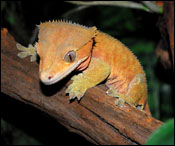
Appearance and Behavior
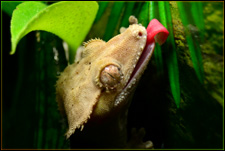
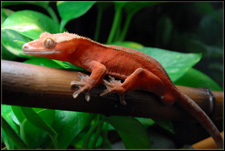
Crested geckos are slim, muscular, and have a crown like crest starting above their eyes that extends all the way to the base of their tails. Crested Geckos are easily hand-tamed, and tolerate occasional handling if they are handled gently & calmly. They have the ability to climb smooth vertical surfaces such as glass, and can jump a considerable distance. Crested Geckos have the ability to drop their tails, a process known as autotomy, to help them evade a predator in nature. A Crested Gecko may drop it's tail in captivity when startled or hurt, and unlike many other species, the tail does not regenerate. In Exo-Terra's most recent New Caledonian expedition, every adult specimen they found was tailless. While this is often avoidable in captivity, it's not a health risk, and not often considered a big problem if a Gecko drops it's tail. Housing hatchling & young Geckos separately has proven to give our Geckos an excellent chance of retaining tails throughout their lives. Crested Geckos are not an aggressive species, and usually only bite when scared or mishandled. In the unlikely event of a bite, the experience for most adults is comparable to a potato chip bag clip being closed on a finger. This is a nocturnal species that's most active at night, but unlike many nocturnal Geckos, they usually remain visible during the day. This is an arboreal species, meaning they spend the majority of their lives living in trees & bushes, off the ground. They have the ability to jump a fair distance (maybe 5-6 body lengths), and should be handled very carefully as hatchlings or subadults. Geckos seem to "blindly jump" while handled less often as they age, especially once the individual becomes comfortable with it's caregiver. Crested Geckos can vocalize, but most commonly only do so during breeding season, or during instances of cagemate aggression.
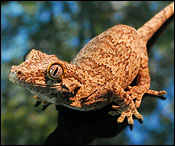
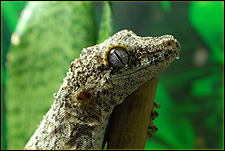
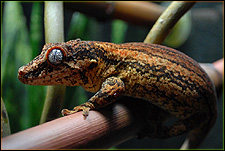
Gargoyle Geckos are more on the chunky & stocky side of the spectrum, and are not able to climb smooth vertical surfaces. In place of the crest, they possess a pair of bumps on their head (earning the name Gargoyle) which begins to visually develop as subadults. Gargoyles also have the ability to drop their tails to help them escape from dangerous situations, which in captivity is most common when they are startled or hurt. Dropped tails will regenerate over the course of a couple months, and usually grow back looking nearly identical to the original. Housing Geckos separately until they are at breeding age greatly minimizes the risks of a dropped tail, and is usually considered the best practice. While Gargoyles do have larger teeth than Crested Geckos, they are another generally friendly species which will not bite unless provoked. While nocturnal, Gargoyles are still occasionally active during the day, often rearranging themselves during misting sessions, and moving to cooler/warmer locations within an enclosure. Like Crested Geckos, Gargoyles are an arboreal species, and have the ability to jump. They are less graceful jumpers than Crested Geckos, and in our experience, don't leap as often. As a Gecko becomes acquainted with it's caregiver, it will tolerate handling more readily. Gargoyle Geckos are capable of vocalizing, which is most commonly audible during breeding season for adults, although we've heard "peeps & grunts" at night from our collection at many times of the year.
What to Look For When Purchasing a Gecko
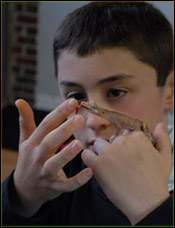
First and foremost, we strongly suggest purchasing from a breeder over a pet store, for the healthiest specimen & best service after the sale. It helps knowing the previous diet, living conditions, and handling routines of the Gecko, which most breeders are happy to help describe.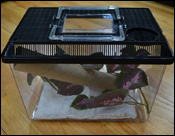
Housing & Caring For Hatchling & Juvenile Geckos
Geckos younger than 5 months require special care, and we suggest keeping handling to a minimum until it has settled into it's new environment for a week or two. Housing each hatchling in it's own enclosure to reduce the risk of tail loss & cage mate aggression is usually the best practice. Small and simple homes are what we recommend to start with when keeping a young Crested or Gargoyle Gecko. The first "grow out" environments are not only inexpensive (Using Herp Havens), but they also make finding food easier, reduce the risks of impaction, and prevent any high fall injuries from occurring. We use herp havens until the Geckos are about 3-4 months old, and later move them to a larger permanent enclosure. A very safe & simple "grow-out" substrate is paper towels, and cage furniture should ideally be solid, easy to climb, and most importantly not something they can accidentally ingest. One easy decor item that young Geckos love is paper towel roll tubes, which can be cut to form different shapes, but there are also many realistic looking decor items & hides available for this purpose. We suggest "function over form" by keeping things fairly simple until the Geckos grow in size to minimize the risk of impaction. Enclosures should be cleaned at least twice per week until the Gecko is 3-4 months of age, when they can safely be placed in a more permanent style home.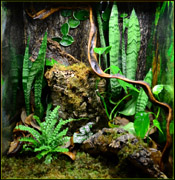
Housing Subadult & Adult Geckos (6 Months + Older)
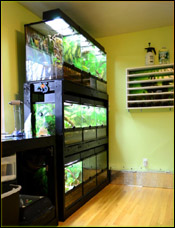
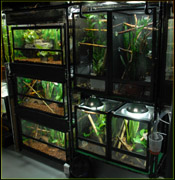
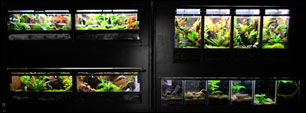
These Geckos are arboreal, so the height is more important than the width of an enclosure. We suggest a bare-minimum of 10 gallons worth of space each, with an enclosure height of 16" or higher for an adult. Larger enclosures are considered much more appropriate, with our staff utilizing a minimum of 18x18x18 (25 gallon) enclosures for individual Geckos, or 18x18x24 (33 gallon) enclosures for pairs. With more space, pairs of Geckos have a little more breathing room, and are far less likely to drop tails, or show signs of aggression. Screen, plastic, or glass enclosures work, but we prefer glass enclosures for the ability to build a nice looking vivarium within.PROs of Simplistic Breeder Terrariums
• Very Inexpensive• Easy/Quick To Build
• Easy to sterilize
• Easy to find eggs
CONs of Simplistic Breeder Terrariums
• Hideous• Medium amount of upkeep
• Easy to sterilize
• Unnatural environment
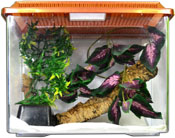
PROs of Naturalistic Terrariums
• Average expense• Nicer aesthetic
• More realistic
CONs of Naturalistic Terrariums
• More difficult to find eggs• More upkeep required
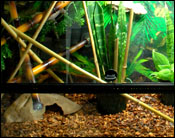
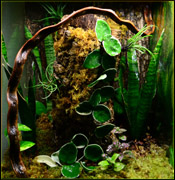
PROs of Live Vivariums
• Best looking option• Least amount of upkeep
• Completely realistic
• Enriching environment
• Eggs can hatch in-vivarium
CONs of Live Vivariums
• High expense• Difficult to find eggs
• More difficult to build
Temperature & Lighting
Each enclosure should contain a hygrometer & thermometer to meter both humidity & temperature in the environment. These species do best when kept between 65-80°F. Anything much over 80°F can cause stress, so try and keep temps below that mark at all times. Most situations won't require an additional heat source, unless ambient room temps are below 65°F in your home. If your home is kept below 65°F, adding a low-wattage heat bulb or under tank heater can assist in keeping temperatures up where they should be. They are fairly heat sensitive, and it's safer to be a little too cool than a little too hot if ideal temps can't be achieved. We suggest using either Jungle Dawn LEDs, or Compact Fluorescent plant bulbs to illuminate enclosures during the day, and utilizing a timer to maintain a healthy circadian rhythm for the Gecko(s). (12 hours on, 12 hours off) UVB lighting is usually considered not necessary for the long-term health of this nocturnal species, although recent studies have suggested it may be beneficial to many Reptile & Amphibian species. For information on illuminating a live vivarium, you can check out ourVivarium Lighting 101 Article.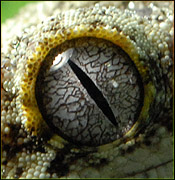
Misting & Humidity
We keep humidity a bit higher than a few other breeders; around 70-80% at night with drops to about 65% during the day. Depending on both the type of terrarium, and the amount of ventilation, this usually requires misting once or twice per day. Misting is extremely important, since these Geckos may not always accept water from a stagnant bowl. Instead, they'll hydrate by licking droplets off of plants & other enclosure decor. Automated misting systems are available to make the process a little less labor intensive, however hand-misting works equally well for this purpose. Either way, we suggest using dechlorinated water for the health of the Gecko(s). Using reverse osmosis filtered water makes a great choice, since it won't leave water marks on the glass.
Feeding
We suggest feeding Repashy Crested Gecko Diets exclusively. (It's called Crested Gecko diet, but it's fine for Gargoyles and many other species, as well) This food is loaded with all the nutrients, vitamins, and minerals a Gecko needs to thrive. It's made as a complete meal replacement solution, and our Geckos absolutely love it. We feed our hatchlings every other day, and juveniles & adults are fed three to four times weekly. Repashy's new Grubs 'n Fruit diet contains extra protein, phosphorus, and calcium, and has been readily accepted by our collection. Nowadays, we offer Grubs 'n Fruit once every 2'nd to 3'rd feeding, as a supplement to the standard Repashy Crested Gecko Diet. Offering a MRP-only diet eliminates the (albeit small) chance of encountering a parasite via feeder insect.Sexing Mature Geckos
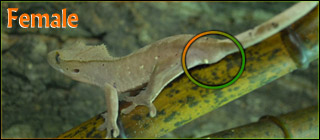
The sex of Crested & Gargoyle Geckos can usually be visually distinguished around 5-7 months of age. The males have an apparent hemipenal bulge which the females lack. The pictures below illustrate this on a Crested Gecko, but it will appear visually similar on a Gargoyle Gecko. Another way to sex these species is by looking for a small row of pores above the vent that usually (but not always) develops on males in the first few months of life. A magnifying glass or loupe is required to see the pores as they develop. We've personally had mixed success with that method, and we usually wait and look for the hemipenal bulge as the most accurate example of sexual dimorphism.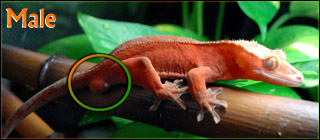
Tips & Tricks
 Although this caresheet pertains to both Crested & Gargoyle geckos, both species should always be housed separately.
To prevent cagemate aggression & possible injuries, never house two Geckos of significantly different sizes together.
Common lingo: "CGD" = Crested Gecko Diet / "MRP" = Meal Replacement Powder (Both the same thing)
A quarantine period is always a good practice to follow for all newly acquired animals.
To prevent cagemate aggression & possible injuries, never house two male Geckos of any size together.
Repashy Gecko Diet can be mixed in small deli cups, and refrigerated for up to 1 week for ease of upkeep.
Until a Gecko is very comfortable, limit handling to 20 minutes for adult Geckos, or 5-10 minutes for younger Geckos to prevent stress.
If you have a jumpy or flighty Gecko, consider hand feeding it a drip of honey (not more than a couple times weekly) to calm it down & encourage socialization.
Avoid handling newly acquired or hatched Geckos until they've had at least a couple weeks to settle in to their new environment.
Handle them gently by allowing it to climb on your hands & arms, as opposed to gripping, grabbing, or restraining a Gecko.
An easy way to pick up a Geckos is by gently placing a finger under it's chin and slowly lifting upwards to encourage it to climb on you.
Housing hatchlings separately can greatly reduce the risk of having them lose a tail, and is considered the best practice @ NEHERP.
Never mix juvenile males & females before they are sexually mature. If the female becomes gravid (pregnant) too young, she can become eggbound & die. If you are interested in breeding Crested or Gargoyle Geckos, or are interested in housing a pair together, check out our more in-depth Breeding Article.
Although this caresheet pertains to both Crested & Gargoyle geckos, both species should always be housed separately.
To prevent cagemate aggression & possible injuries, never house two Geckos of significantly different sizes together.
Common lingo: "CGD" = Crested Gecko Diet / "MRP" = Meal Replacement Powder (Both the same thing)
A quarantine period is always a good practice to follow for all newly acquired animals.
To prevent cagemate aggression & possible injuries, never house two male Geckos of any size together.
Repashy Gecko Diet can be mixed in small deli cups, and refrigerated for up to 1 week for ease of upkeep.
Until a Gecko is very comfortable, limit handling to 20 minutes for adult Geckos, or 5-10 minutes for younger Geckos to prevent stress.
If you have a jumpy or flighty Gecko, consider hand feeding it a drip of honey (not more than a couple times weekly) to calm it down & encourage socialization.
Avoid handling newly acquired or hatched Geckos until they've had at least a couple weeks to settle in to their new environment.
Handle them gently by allowing it to climb on your hands & arms, as opposed to gripping, grabbing, or restraining a Gecko.
An easy way to pick up a Geckos is by gently placing a finger under it's chin and slowly lifting upwards to encourage it to climb on you.
Housing hatchlings separately can greatly reduce the risk of having them lose a tail, and is considered the best practice @ NEHERP.
Never mix juvenile males & females before they are sexually mature. If the female becomes gravid (pregnant) too young, she can become eggbound & die. If you are interested in breeding Crested or Gargoyle Geckos, or are interested in housing a pair together, check out our more in-depth Breeding Article.
 If you have any questions at all about the info in this article, don't hesitate to contact us. We're happy to help!